1. 概念引入
在说明构造函数和析构函数的概念之前, 首先看一个例子
下面这段代码是栈经典的应用场景括号匹配
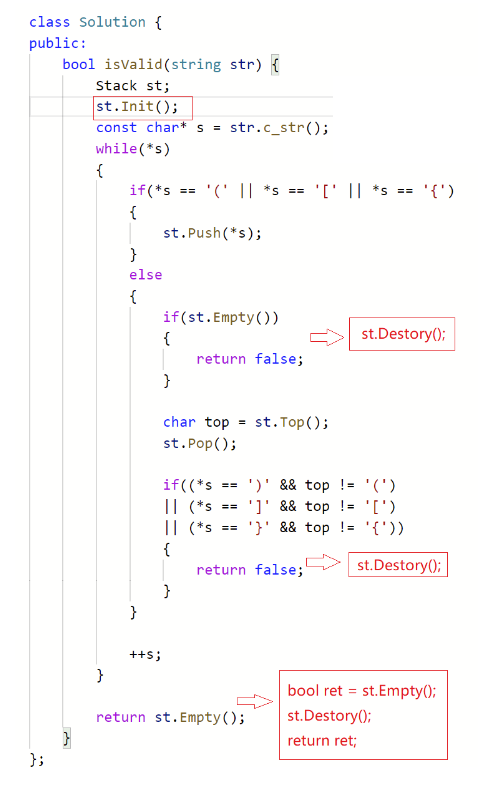
如图, 栈必须先初始化,然后在每一个return false之前都需要销毁栈, 不然就会内存泄漏
这样很繁琐, 而且有些时候很容易忘记写, 所以在C++中添加默认的成员函数,构造函数和析构函数来自动进行初始化和清理工作
2. 6个默认的成员函数
这6个默认的成员函数都是编译器自动生成的, 它们自动进行不同的工作, 如下

本章详细说明其中的两个, 构造函数和析构函数
3. 构造函数
概念及特性
构造函数是特殊的成员函数,需要注意的是,构造函数虽然名称叫构造,但是构造函数的主要任务并不是开空间创建对象,而是初始化对象
其特征如下:
- 函数名与类名相同
- 无返回值
- 对象实例化时编译器自动调用对应的构造函数
- 构造函数可以重载
- 如果类中没有显式定义构造函数,则C++编译器会自动生成一个无参的默认构造函数,一旦用户显式定义编译器将不再生成
特性解析
下面用栈来解析特性:
1. 函数名与类名相同
2. 无返回值
3. 对象实例化时编译器自动调用对应的构造函数
stack.cpp
#include <iostream>
using namespace std;
typedef int DataType;
class Stack
{
public:

	// 函数名与类名相同, 无返回值
	Stack()
	{
		_array = (DataType*)malloc(sizeof(DataType) * 4);
		if (NULL == _array)
		{
			perror("malloc申请空间失败!!!");
			return;
		}

		_capacity = 4;
		_size = 0;
	}

	/*void Init()
	{
		_array = (DataType*)malloc(sizeof(DataType) * 4);
		if (NULL == _array)
		{
			perror("malloc申请空间失败!!!");
			return;
		}

		_capacity = 4;
		_size = 0;
	}*/

	void Push(DataType data)
	{
		CheckCapacity();
		_array[_size] = data;
		_size++;
	}

	void Pop()
	{
		if (Empty())
			return;
		_size--;
	}

	DataType Top() { return _array[_size - 1]; }
	int Empty() { return 0 == _size; }
	int Size() { return _size; }

	void Destroy()
	{
		if (_array)
		{
			free(_array);
			_array = NULL;
			_capacity = 0;
			_size = 0;
		}
	}

private:
	void CheckCapacity()
	{
		if (_size == _capacity)
		{
			int newcapacity = _capacity * 2;
			DataType* temp = (DataType*)realloc(_array, newcapacity * sizeof(DataType));
			if (temp == NULL)
			{
				perror("realloc申请空间失败!!!");
				return;
			}
			_array = temp;
			_capacity = newcapacity;
		}
	}
private:
	DataType* _array;
	int _capacity;
	int _size;
};

int main()
{
	Stack s; // 自动调用构造函数
	//s.Init();
	s.Push(1);
	s.Push(2);
	s.Push(3);
	s.Push(4);
}

4. 构造函数可以重载
构造函数支持重载是因为可能会有多种初始化的场景

5. 如果类中没有显式定义构造函数,则C++编译器会自动生成一个无参的默认构造函数,一旦用户显式定义编译器将不再生成
#include <iostream>
using namespace std;

class Date
{
public:
	void Init(int year, int month, int day)
	{
		_year = year;
		_month = month;
		_day = day;
	}
	void Print() // 3. void Print(Date* this)
	{
		cout << this->_year << "-" << this->_month << "-" << this->_day << endl;
	}
private:
	int _year;     // 年
	int _month;    // 月
	int _day;      // 日
};
int main()
{
	Date d1, d2;
	//d1.Init(2022, 1, 11);
	//d2.Init(2023, 4, 28);
	d1.Print();
	//d1.Print(&d1);
	//d2.Print();
	//d2.print(&d2);
}
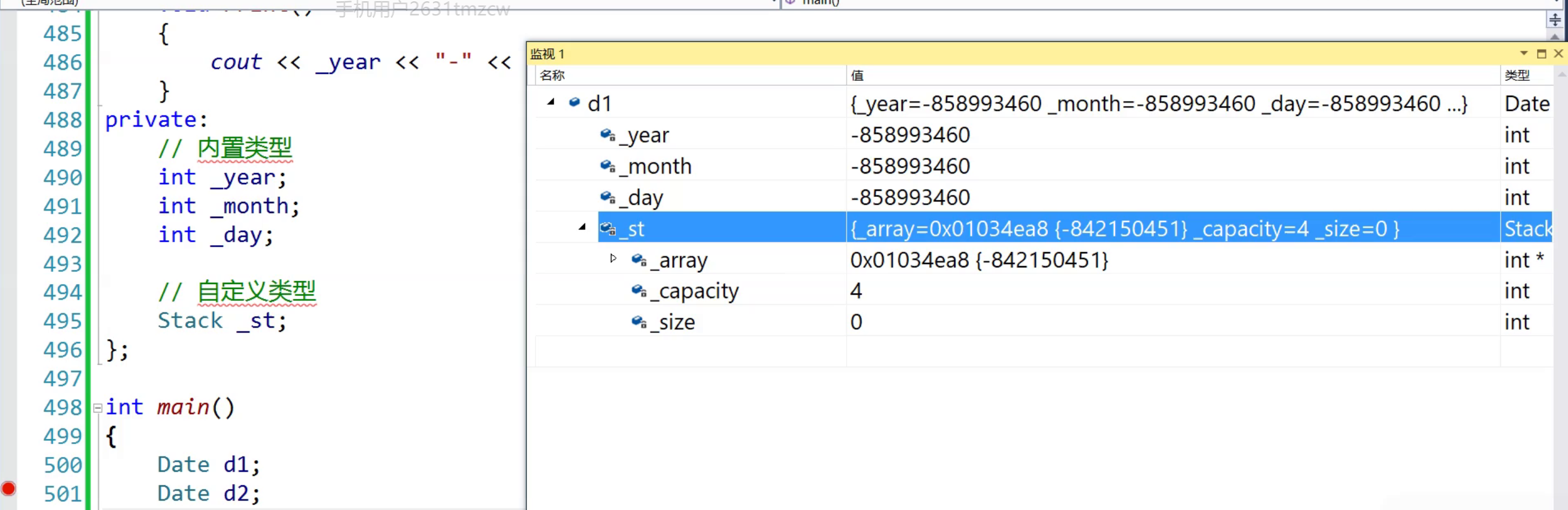
从图中, 发现编译器默认生成的构造函数好像并没有进行初始化, 依旧是随机值
这是因为C++标准规定内置类型(char, int...)不做处理(置0), 但是自定义类型(class, struct)会去调用它的默认构造函数处理初始化, 如下图
test.cpp
 #include <iostream>
using namespace std;
typedef int DataType;
class Stack
{
public:
	/*Stack(DataType* a, int n)
	{
		cout << "Stack(DataType* a, int n)" << endl;
		_array = (DataType*)malloc(sizeof(DataType) * n);
		if (NULL == _array)
		{
			perror("malloc申请空间失败!!!");
			return;
		}
		memcpy(_array, a, sizeof(DataType) * n);

		_capacity = n;
		_size = n;
	}*/

	Stack(int capacity = 4)
	{
		cout << "Stack(int capacity = 4)" << endl;
		_array = (DataType*)malloc(sizeof(DataType) * capacity);
		if (NULL == _array)
		{
			perror("malloc申请空间失败!!!");
			return;
		}

		_capacity = capacity;
		_size = 0;
	}

	/*void Init()
	{
		_array = (DataType*)malloc(sizeof(DataType) * 4);
		if (NULL == _array)
		{
			perror("malloc申请空间失败!!!");
			return;
		}

		_capacity = 4;
		_size = 0;
	}*/

	void Push(DataType data)
	{
		CheckCapacity();
		_array[_size] = data;
		_size++;
	}

	void Pop()
	{
		if (Empty())
			return;
		_size--;
	}

	DataType Top() { return _array[_size - 1]; }
	int Empty() { return 0 == _size; }
	int Size() { return _size; }

	/*void Destroy()
	{
		if (_array)
		{
			free(_array);
			_array = NULL;
			_capacity = 0;
			_size = 0;
		}
	}*/

	~Stack()
	{
		cout << "~Stack()" << endl;
		if (_array)
		{
			free(_array);
			_array = NULL;
			_capacity = 0;
			_size = 0;
		}
	}

private:
	void CheckCapacity()
	{
		if (_size == _capacity)
		{
			int newcapacity = _capacity * 2;
			DataType* temp = (DataType*)realloc(_array, newcapacity * sizeof(DataType));
			if (temp == NULL)
			{
				perror("realloc申请空间失败!!!");
				return;
			}
			_array = temp;
			_capacity = newcapacity;
		}
	}
private:
	DataType* _array;
	int _capacity;
	int _size;
};

class Date
{
public:
	void Init(int year, int month, int day)
	{
		_year = year;
		_month = month;
		_day = day;
	}
	void Print() // 3. void Print(Date* this)
	{
		cout << this->_year << "-" << this->_month << "-" << this->_day << endl;
	}
private:
    // 内置类型
	int _year;     // 年
	int _month;    // 月
	int _day;      // 日
    // 自定义类型
	Stack st;
};
int main()
{
	Date d1, d2;
	//d1.Init(2022, 1, 11);
	//d2.Init(2023, 4, 28);
	d1.Print();
	//d1.Print(&d1);
	//d2.Print();
	//d2.print(&d2);
}
在C++11中, 为了弥补内置类型成员不初始化的缺陷,打了补丁 (内置类型成员变量在类中声明时可以给默认值)
class Date
{
public:
	void Init(int year, int month, int day)
	{
		_year = year;
		_month = month;
		_day = day;
	}
	void Print() // 3. void Print(Date* this)
	{
		cout << this->_year << "-" << this->_month << "-" << this->_day << endl;
	}
private:
	// 不是初始化, 而是默认的缺省值
	int _year = 1;
	int _month = 1;
	int _day = 1;
};
int main()
{
	Date d1, d2;
	d1.Print();
}
构造函数的调用
构造函数的调用与普通函数不同, 如下例
class Date
{
public:
	Date()
	{
		_year = 1;
		_month = 1;
		_day = 1;
	}
	Date(int year = 1, int month = 1, int day = 1)
	{
		_year = year;
		_month = month;
		_day = day;
	}
	void Init(int year, int month, int day)
	{
		_year = year;
		_month = month;
		_day = day;
	}
	void Print() // 3. void Print(Date* this)
	{
		cout << this->_year << "-" << this->_month << "-" << this->_day << endl;
	}
private:
	// 不是初始化, 而是缺省值(默认值)
	int _year = 1;
	int _month = 1;
	int _day = 1;
};
int main()
{
	Date d1(2222,2,2); // 构造函数的调用
	d1.Print();
}
默认的构造函数
编译器默认生成的构造函数,无参的构造函数和全缺省的构造函数都称为默认构造函数,且默认构造函数只能有一个


类实例化对象时会自动调用构造函数, 但是由于有两个默认的构造函数, 所以报错
4. 析构函数
概念及特性
析构函数与构造函数功能相反, 完成对象中资源的清理工作
注意: 析构函数不是完成对对象本身的销毁而是对象中的资源, 局部对象本身的销毁工作是由编译器完成的
特性如下:
- 析构函数名是在类名前加上字符 ~
- 无参数无返回值类型
- 对象生命周期结束时,C++编译系统系统自动调用析构函数
- 一个类只能有一个析构函数。若未显式定义,系统会自动生成默认的析构函数。注意:析构函数不能重载
- 关于编译器自动生成的析构函数,是否会完成一些事情呢?下面的程序我们会看到,编译器生成的默认析构函数,对自定类型成员调用它的析构函数
解析特性
下面还是用栈来解析这些特性:
析构函数名是在类名前加上字符 ~
无参数无返回值类型
对象生命周期结束时,C++编译系统系统自动调用析构函数
stack.cpp
 #include <iostream>
using namespace std;
typedef int DataType;
class Stack
{
public:

	// 函数名与类名相同, 无返回值
	Stack()
	{
		_array = (DataType*)malloc(sizeof(DataType) * 4);
		if (NULL == _array)
		{
			perror("malloc申请空间失败!!!");
			return;
		}

		_capacity = 4;
		_size = 0;
	}

	/*void Init()
	{
		_array = (DataType*)malloc(sizeof(DataType) * 4);
		if (NULL == _array)
		{
			perror("malloc申请空间失败!!!");
			return;
		}

		_capacity = 4;
		_size = 0;
	}*/

	void Push(DataType data)
	{
		CheckCapacity();
		_array[_size] = data;
		_size++;
	}

	void Pop()
	{
		if (Empty())
			return;
		_size--;
	}

	DataType Top() { return _array[_size - 1]; }
	int Empty() { return 0 == _size; }
	int Size() { return _size; }

	// 析构函数
	~Stack()
	{
		if (_array)
		{
			free(_array);
			_array = NULL;
			_capacity = 0;
			_size = 0;
		}
	}
	/*void Destroy()
	{
		if (_array)
		{
			free(_array);
			_array = NULL;
			_capacity = 0;
			_size = 0;
		}
	}*/

private:
	void CheckCapacity()
	{
		if (_size == _capacity)
		{
			int newcapacity = _capacity * 2;
			DataType* temp = (DataType*)realloc(_array, newcapacity * sizeof(DataType));
			if (temp == NULL)
			{
				perror("realloc申请空间失败!!!");
				return;
			}
			_array = temp;
			_capacity = newcapacity;
		}
	}
private:
	DataType* _array;
	int _capacity;
	int _size;
};

int main()
{
	Stack s; // 对象实例化时编译器自动调用对应的构造函数
	//s.Init();
	s.Push(1);
	s.Push(2);
	s.Push(3);
	s.Push(4);
	//s.Destroy();
}
