#include <stdio.h>
#include <stdlib.h>
#include <time.h>
#include <windows.h>
#define N 80
void print_text(int line, int col, char text[]); // 函数声明
void print_spaces(int n); // 函数声明
void print_blank_lines(int n); // 函数声明
int main() {
    int line, col, i;
    char text[N] = "hi, November~";
    srand(time(0)); // 以当前系统时间作为随机种子
    for (i = 1; i <= 10; ++i) {
        line = rand() % 25;
        col = rand() % 80;
        print_text(line, col, text);
        Sleep(1000); // 暂停1000ms
    }
    return 0;
}
// 打印n个空格
void print_spaces(int n) {
    int i;
    for (i = 1; i <= n; ++i)
        printf(" ");
}
// 打印n行空白行
void print_blank_lines(int n) {
    int i;
    for (i = 1; i <= n; ++i)
        printf("\n");
}
// 在第line行第col列打印一段文本
void print_text(int line, int col, char text[]) {
    print_blank_lines(line - 1); // 打印(line-1)行空行
    print_spaces(col - 1); // 打印(col-1)列空格
    printf("%s", text); // 在第line行、col列输出text中字符串
}
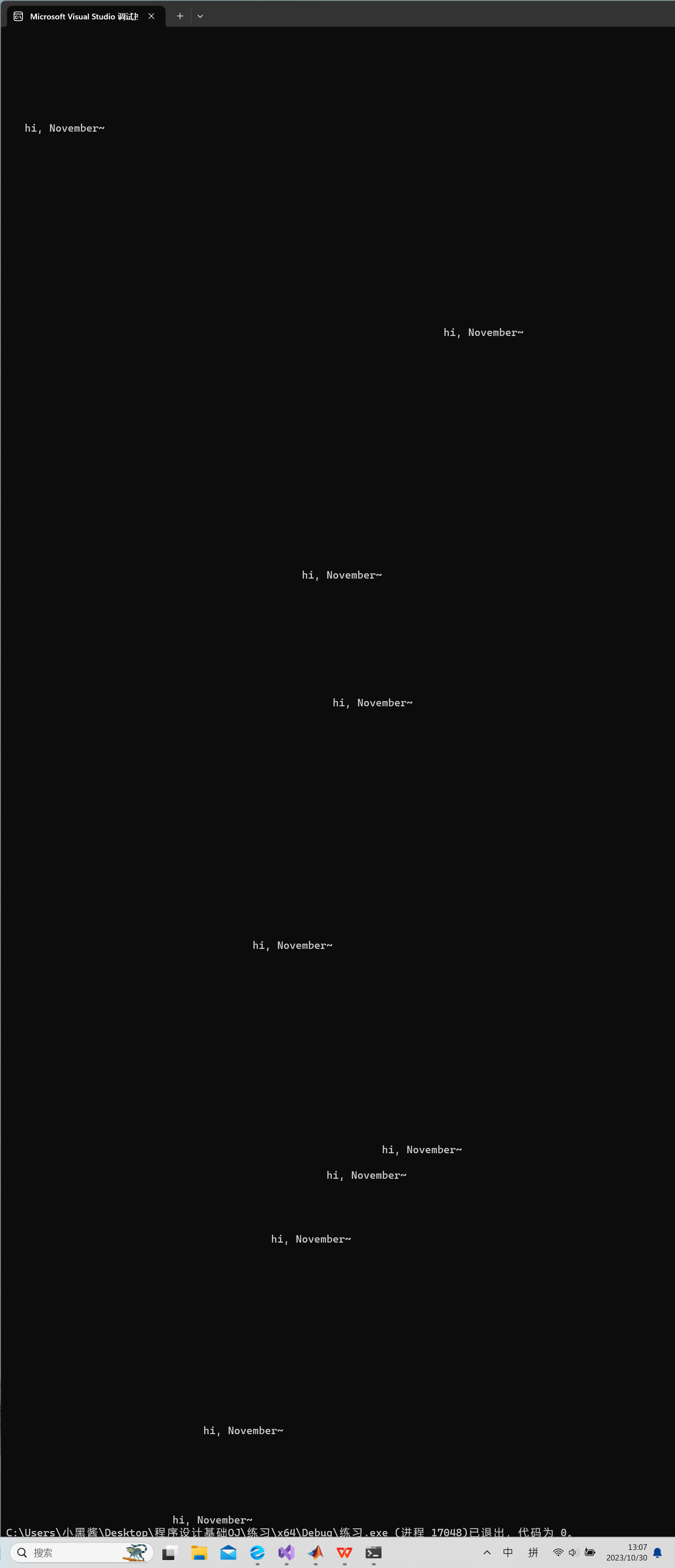
程序作用:随机在某行某列打印text文本
#define _CRT_SECURE_NO_WARNINGS
#include <stdio.h>
#include <math.h>
long long fac(int n); // 函数声明
int main() {
    int i, n;
    printf("Enter n: ");
    scanf("%d", &n);
    for (i = 1; i <= n; ++i)
        printf("%d! = %lld\n", i, fac(i));
    return 0;
}
// 函数定义
long long fac(int n) {
    static long long p = 1;
    p = p * n;
    return p;
}

该静态变量的作用是在函数中起到存储上一步调用该函数的结果
经过分析下面程序的结果为:8 17
#define _CRT_SECURE_NO_WARNINGS
#include <stdio.h>
#include <math.h>
int func(int, int); // 函数声明
int main() {
    int k = 4, m = 1, p1, p2;
    p1 = func(k, m); // 函数调用
    p2 = func(k, m); // 函数调用
    printf("%d, %d\n", p1, p2);
    return 0;
}
// 函数定义
int func(int a, int b) {
    static int m = 0, i = 2;
    i += m + 1;
    m = i + a + b;
    return m;
}

#define _CRT_SECURE_NO_WARNINGS
#include <stdio.h>
#include <math.h>
long long func(int n); // 函数声明
int main() {
    int n;
    long long f;
    while (scanf("%d", &n) != EOF) {
        f = func(n); // 函数调用
        printf("n = %d, f = %lld\n", n, f);
    }
    return 0;
}

long long func(int n) {
    static int f = 1;
    if (n == 0) {
        int f1 = f;
        f = 1;
        return f1 - 1;
    }
    f *= 2;
    func(n - 1);
}

#define _CRT_SECURE_NO_WARNINGS
#include <stdio.h>
#include <math.h>
int func(int n, int m);
int main() {
    int n, m;
    while (scanf("%d%d", &n, &m) != EOF)
        printf("n = %d, m = %d, ans = %d\n", n, m, func(n, m));
    return 0;
}
int func(int n, int m) {
    double x=1.0;
    for (int i = 0; i < m; i++) {
        x *= (double)(n - i) / (m - i);
    }
    return (int)x;
}

#define _CRT_SECURE_NO_WARNINGS
#include <stdio.h>
#include <math.h>
int func(int n, int m);
int main() {
    int n, m;
    while (scanf("%d%d", &n, &m) != EOF)
        printf("n = %d, m = %d, ans = %d\n", n, m, func(n, m));
    return 0;
}
int func(int n, int m) {
    int x = 0;
    if (m > n)return 0;
    else if (m == 0)return 1;
    else if (m == n)return 1;
    x = func(n - 1, m) + func(n - 1, m - 1);
}

#define _CRT_SECURE_NO_WARNINGS
#include <stdio.h>
#include <math.h>
int sum;
void move(char x, int n, char y) {
    printf("%d:%c-->%c\n", n, x, y);
    sum++;
}
void hanoi(int n, char x, char y, char z) {
    if (n == 1)move(x, 1, z);
    else {
        hanoi(n - 1, x, z, y);
        move(x, n, z);
        hanoi(n - 1, y, x, z);
    }
}

int main() {
    int n;
    while (scanf("%d", &n) != EOF) {
        sum = 0;
        hanoi(n, 'A', 'B', 'C');
        printf("一共移动了%d次.\n",sum);
    }
}

#define _CRT_SECURE_NO_WARNINGS
#include <stdio.h>
#include <math.h>
long func(long s); // 函数声明
int main() {
    long s, t;
    printf("Enter a number: ");
    while (scanf("%ld", &s) != EOF) {
        t = func(s); // 函数调用
        printf("new number is: %ld\n\n", t);
        printf("Enter a number: ");
    }
    return 0;
}

long func(long s) {
    int count = 0;
    int sum = 0;
    while (s / 10 != 0) {
        int temp = 0;
        temp = s % 10;
        if (temp % 2 != 0) {
            sum += temp * pow(10, count);
            count++;
        }
        s = s / 10;
    }
    if (s % 2 != 0)sum += s * pow(10, count);
    return sum;
}
