Python List Comprehensions All In One
列表推导式
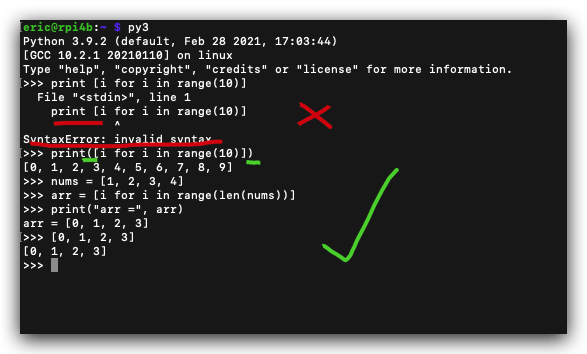
print([i for i in range(10)])
[0, 1, 2, 3, 4, 5, 6, 7, 8, 9]

print([i for i in range(20) if i%2 == 0])
[0, 2, 4, 6, 8, 10, 12, 14, 16, 18]

nums = [1, 2, 3, 4]
arr = [i for i in range(len(nums))]
print("arr =", arr)
[0, 1, 2, 3]
nums = [1, 2, 3, 4]
fruit = ["Apples", "Peaches", "Pears", "Bananas"]

print([(i, f) for i in nums for f in fruit])
[(1, 'Apples'), (1, 'Peaches'), (1, 'Pears'), (1, 'Bananas'),
 (2, 'Apples'), (2, 'Peaches'), (2, 'Pears'), (2, 'Bananas'),
 (3, 'Apples'), (3, 'Peaches'), (3, 'Pears'), (3, 'Bananas'),
 (4, 'Apples'), (4, 'Peaches'), (4, 'Pears'), (4, 'Bananas')]
BDFL Pronouncements
The syntax proposed above is the Right One.
The form [x, y for ...] is disallowed; ❌
one is required to write [(x, y) for ...] ✅
The form [... for x... for y...] nests, with the last index varying fastest, just like nested for loops. ?
https://peps.python.org/pep-0202/
List displays
list_display ::= "[" [starred_list | comprehension] "]"
https://docs.python.org/3/reference/expressions.html#list-displays
REPL
https://www.runoob.com/try/runcode.php?filename=HelloWorld&type=python3
demos
list, enumerate, range, lambda, for...loop
#  ?
# class Solution:
#   def runningSum(self, nums: List[int]) -> List[int]:
#     for i, item in enumerate(nums):
#       if(i > 0):
#         nums[i] += nums[i - 1]
#     return nums
#  ?
# class Solution:
#   def runningSum(self, nums: List[int]) -> List[int]:
#     for i in range(1,len(nums)):
#       nums[i] += nums[i - 1]
#     return nums

class Solution:
  def runningSum(self, nums: List[int]) -> List[int]:
    for i in [for x in len(nums) - 1: x]:
      nums[i] += nums[i - 1]
    return nums

# class Solution:
#   def runningSum(self, nums: List[int]) -> List[int]:
#     for i in range(len(nums)):
#       if(i > 0):
#         nums[i] += nums[i - 1]
#     return nums

#

# class Solution:
#   def runningSum(self, nums: List[int]) -> List[int]:
#     temp = 0
#     result = []
#     for item in nums:
#       temp += item
#       result.append(temp)
#     return result


# class Solution:
#   def runningSum(self, nums: List[int]) -> List[int]:
#     result = []
#     for i, item in enumerate(nums):
#       result.append(item)
#       for j in range(len(result) - 1):
#         result[i] += nums[j]
#     return result
https://leetcode.com/problems/running-sum-of-1d-array/submissions/
#!/usr/bin/python3

nums = [1,2,3,4,5]
arr = [x for x in nums[1:]]
print("arr =", arr)

for j in nums[1:]:
  print("j =", j)

"""
$ py3 ./list-for-loop.py

arr = [2, 3, 4, 5]
j = 2
j = 3
j = 4
j = 5

"""
python dynamic create list
python create list with for loop one line
https://stackoverflow.com/questions/1545050/python-one-line-for-expression
(? 反爬虫测试!打击盗版⚠️)如果你看到这个信息, 说明这是一篇剽窃的文章,请访问 https://www.cnblogs.com/xgqfrms/ 查看原创文章!
refs
©xgqfrms 2012-2021
www.cnblogs.com/xgqfrms 发布文章使用:只允许注册用户才可以访问!
原创文章,版权所有©️xgqfrms, 禁止转载 ?️,侵权必究⚠️!